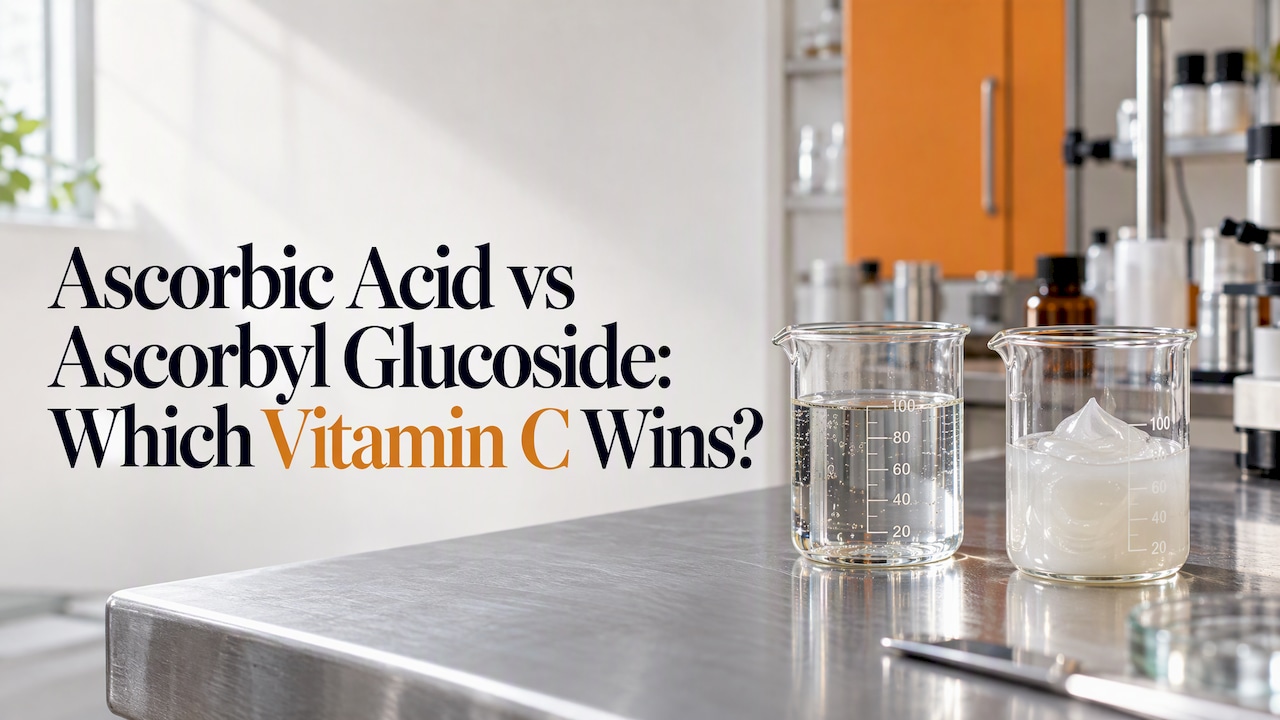
L-ascorbic acid is the active form of vitamin C and the more direct one, but it is unstable and needs an acidic formula. Ascorbyl glucoside is a vitamin C that is bound to glucose. It is far more stable, works at a skin-friendly pH, and the skin converts it into ascorbic acid. Neither is better in every case. The right choice depends on the skin you are formulating for, the texture you want and how long the product must stay potent on a shelf in Singapore’s warm, humid climate.
This guide is written for brand owners, salons and clinicians who are choosing a vitamin C for a product, and for curious consumers who want to read an ingredient list with confidence.
TL;DR
- L-ascorbic acid is the chemically active form, but it is unstable in water and works best at a low pH, typically below 3.5.
- Ascorbyl glucoside is a stable pro-drug: the skin metabolises it into ascorbic acid, and it can be formulated at physiological pH.
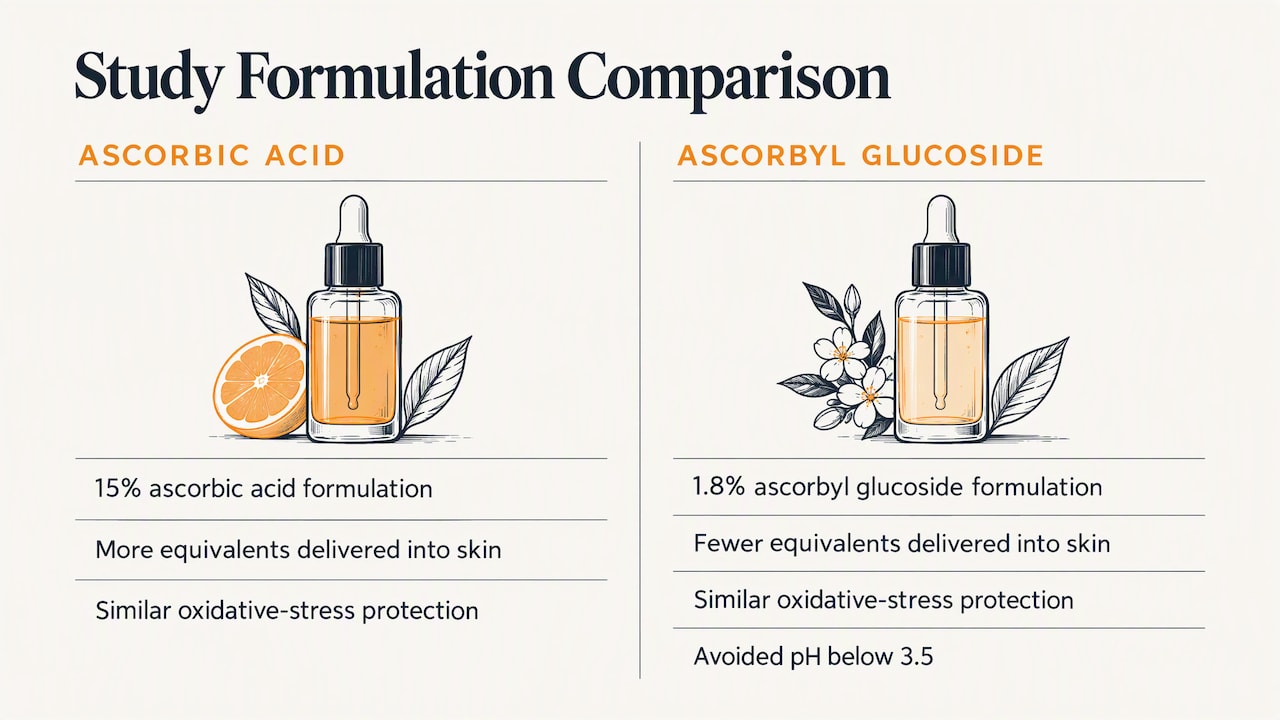
- In one study, 1.8% ascorbyl glucoside gave antioxidant protection similar to 15% ascorbic acid, although the acid delivered more vitamin C into the skin.
- Head-to-head clinical trials are limited, so the finished formula, not the ingredient name, should be proven by testing.
- In Singapore, a vitamin C product is still a cosmetic that must be notified to HSA before sale, subject to the stated exemptions.
Table of Contents
- What each ingredient actually is
- Ascorbic acid vs ascorbyl glucoside at a glance
- What the evidence says about potency
- Stability: why it drives most decisions
- Skin tolerance and everyday comfort
- Choosing between them: a practical framework
- Our perspective
- What Singapore brands must remember
- Developing your vitamin C product with us
- Reading a label: what to look for
- FAQ
- Sources
What each ingredient actually is
Ascorbic acid and L-ascorbic acid
People use “ascorbic acid” and “L-ascorbic acid” almost interchangeably on labels and in search boxes. In skincare the distinction matters little: L-ascorbic acid is the chemically active form of ascorbic acid used in medical practice. It is what the skin ultimately needs to do its job in collagen synthesis and antioxidant defence. Formulators sometimes call it the “pure” or “free” form.
The catch is chemistry. It is hydrophilic, it is unstable in aqueous solutions, and, because it is charged, it needs a low pH, typically below 3.5, for the best stability and skin penetration. That is why classic vitamin C serums are acidic, can sting on sensitive skin and often darken as the ingredient oxidises.
Ascorbyl glucoside
Ascorbyl glucoside (also written ascorbic acid 2-glucoside, or AA2G) combines ascorbic acid with a glucose molecule. The sugar protects the vulnerable part of the vitamin. Once on the skin, enzymes remove it: research describes ascorbic acid 2-glucoside as being metabolised to ascorbic acid by the skin and as chemically stable under storage conditions. In other words, it is a pro-drug: inactive and sturdy in the bottle, then converted to the active vitamin in the skin.
You may also see it called vitamin CG. It sits in the family of vitamin C derivatives, alongside the phosphate and palmitate esters, which are different molecules with their own behaviour and are not covered in this comparison.
Ascorbic acid vs ascorbyl glucoside at a glance
| Factor | L-ascorbic acid | Ascorbyl glucoside |
|---|---|---|
| Form | Active vitamin C | Pro-drug, converted to ascorbic acid in the skin |
| Stability in water | Low, oxidises easily | High under storage conditions |
| Typical formula pH | Below 3.5 | Can be formulated at physiological pH |
| Tolerance | Acidic formulas can sting sensitive skin | Generally suited to gentler, near-neutral formulas |
| Delivery of vitamin C into skin | Higher in the study below | Lower, but effective in specific models |
| Packaging demands | Airtight, protected from air and light | Less demanding, though good packaging still helps |
| Best fit | Targeted, potency-led serums | Daily, comfort-led creams, lotions and serums |
What the evidence says about potency
The most useful head-to-head data come from a study that compared the two. The 15% ascorbic acid formulation delivered more ascorbic-acid equivalents into skin than 1.8% ascorbyl glucoside, but their protective effects against oxidative stress were similar. The same research notes that the glucoside avoided the need for an acidic formulation below pH 3.5.
Two lessons follow. First, a much lower dose of the derivative can still produce a comparable antioxidant outcome in specific models. Second, “more vitamin C in the skin” and “better result” are not the same thing, so potency on a label is a poor guide on its own.
A word of caution that a careful formulator respects: comparative clinical trials between L-ascorbic acid and its derivatives remain limited, and experts advise against treating laboratory findings as a guarantee of performance on real skin. Any efficacy claim should be backed by clinical evidence for the final formulated product. That is a sound rule for brands: the ingredient is only one part of the story. The base, the pH, the packaging and the concentration decide what the customer experiences.
Stability: why it drives most decisions
Stability is where the two ingredients diverge most, and it is the reason many brands move to a derivative.
Ascorbic acid: protect it from air and water
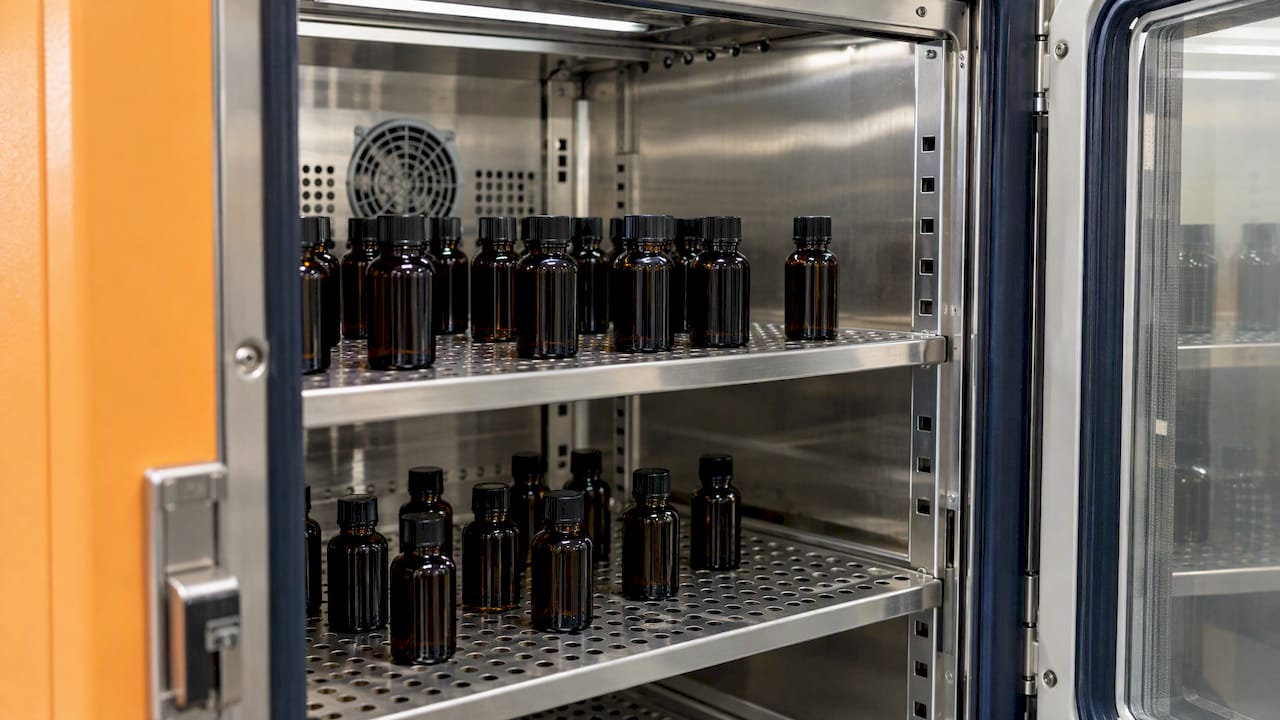
An aqueous L-ascorbic acid preparation can be kept stable, but it takes work. Professional guidance points to airtight packaging, lower water activity, controlled pH and effective chelating agents as the main levers. In practice this means airless pumps or small dark bottles, careful manufacturing to limit oxygen, and stability testing across the temperatures and humidity levels the product will meet in Southeast Asia.
Ascorbyl glucoside: stable, with a sweet spot
Ascorbyl glucoside is far more forgiving. A safety assessment reports its highest stability in cosmetic products at around 55.3°C and pH 6.4. You do not need to sit at that exact point, but it shows how comfortably the ingredient lives at a mild pH that suits most skin types. That makes it easier to build into creams, lotions and gel-creams that need to stay pleasant to use over many months.
One point applies to both: the benefit of any topical vitamin C depends on formulation characteristics, and derivatives generally must be enzymatically converted to ascorbic acid before they work. A stable ingredient that the skin converts poorly would be pointless, which is again why finished-product testing matters.
For a deeper look at how pH, antioxidants and manufacturing steps interact, see our guide to vitamin C serum formulation. If you are planning to prove shelf life, our page on cosmetic stability testing and QC explains what we check.
Skin tolerance and everyday comfort
An acidic serum is a reasonable trade for people who tolerate it, but it is not for everyone. Because ascorbyl glucoside can be formulated at physiological pH, it avoids the acidity that makes some people with reactive skin avoid vitamin C altogether. That makes it a natural candidate for daily-use products aimed at a broad audience, including consumers who are new to vitamin C.
On safety, the Cosmetic Ingredient Review panel looked at the ingredient closely. The assessment states that ascorbyl glucoside is used in face and neck products at concentrations up to 5%, and that the panel concluded in 2024 that ascorbyl glucoside and sodium ascorbyl glucoside are safe for use in cosmetics under current industry practices.
As with any active, patch testing is sensible. Anyone with a skin condition, or who is under dermatological care, should check with their doctor or dermatologist before adding a new active to their routine.
Choosing between them: a practical framework
Use these questions to decide which vitamin C belongs in your product.
- Who is the customer? Sensitive or first-time users usually do better with a gentler, near-neutral derivative formula. Experienced users who want a classic, potent serum may prefer L-ascorbic acid.
- What texture and format do you want? A rich cream or emulsion sits more naturally at a mild pH. A thin, watery serum is the traditional home of low-pH ascorbic acid.
- What packaging can you afford? Ascorbic acid rewards airless, opaque packaging. Our overview of skincare packaging options for Singapore brands walks through the choices.
- How long must it last? Long shelf life in a tropical climate favours the more stable ingredient, or a well-engineered acid formula with proven testing.
- How will you market it? Describe the claim you can support. Cosmetic claims about brightening or antioxidant care sit differently from therapeutic ones, which is covered in the regulatory section below.
Some brands combine the two, using a stable derivative for daily comfort and a small low-pH treatment for targeted use. Whether that makes sense depends on your range, and it should be tested as a finished system rather than assumed.
Our perspective
At Harmony Skin Lab we see the same pattern with new brands. They ask which vitamin C is “strongest”, when the better question is which one will still be performing, and still be comfortable, when a customer opens the bottle in month six.
Our view is that vitamin C is a formulation problem before it is an ingredient choice. The evidence shows that a stable derivative such as ascorbyl glucoside can deliver antioxidant protection at a modest dose and at a skin-friendly pH, while L-ascorbic acid remains the direct, active form for those who want it and are willing to engineer the formula and packaging around it. We are designed to work with you on either route.
That is why we build collaboratively: we agree the customer, the claim and the texture first, then run the R&D, GMP-certified manufacturing and stability checks so the result is a product you can stand behind, whether it is for home use, a professional salon line or a clinic.
Edmund
What Singapore brands must remember
Choosing the ingredient is only half the journey. In Singapore, manufacturers and importers supplying cosmetics must notify HSA before selling them, subject to the stated exemptions. Our practical guide to HSA cosmetic notification and our explainer on the ASEAN Cosmetic Directive cover the steps and the labelling expectations.
The dividing line between a cosmetic and a product making therapeutic claims also matters. A serum promising to treat a skin condition may belong under a different regulatory pathway from one that simply brightens the look of skin or provides antioxidant care. Our article on cosmeceutical vs cosmetic helps you decide how to word claims, and the page on GMP in cosmetics explains what Singapore expects of the facility that makes your product.
Developing your vitamin C product with us
If you are launching a vitamin C range, we can take you from concept to finished goods: custom formulation, R&D, quality control and packaging, all under one roof in Singapore. We hold GMP certification from HSA, and our approach is to work alongside you so the product fits your market and your customer. You can see how we work on our services page, or read how custom skincare formulation works from concept to production.
Ready to talk about your formula? Contact Harmony Skin Lab with your target customer and format, and we will help you choose between ascorbic acid, ascorbyl glucoside or a combined approach. If you are new to the process, our seven steps to launch private label cosmetics in Singapore gives the full roadmap, and our page on low MOQ skincare manufacturing is useful for first runs.
Reading a label: what to look for
If you are a consumer rather than a brand, the ingredient list tells you most of what you need. “Ascorbic acid” or “L-ascorbic acid” signals the active form, so expect an acidic, often thin serum that should be kept closed, cool and away from light. “Ascorbyl glucoside” signals the stable derivative, which tends to appear in gentler daily products.
Percentages are only part of the picture. A 1.8% glucoside and a 15% acid cannot be compared by number alone, as the study above shows: the lower figure produced a similar antioxidant effect in that model. Look instead for brands that can show testing on the finished product, and apply sunscreen every morning, because vitamin C is a partner to sun protection and never a replacement for it.
For professional use, such as in salons and clinics, the same logic applies with different priorities: predictable results across a treatment course, clear instructions for aftercare and a formula that stays stable in a treatment room. Our pages on professional salon skincare manufacturing and aesthetic skincare for clinics in Singapore describe how we support those lines.
FAQ
Is ascorbyl glucoside as good as L-ascorbic acid?
It can be comparable for antioxidant protection, although the two behave differently. In one study, 1.8% ascorbyl glucoside gave antioxidant effects similar to 15% ascorbic acid, while the acid delivered more vitamin C into the skin. Because clinical comparisons are limited, results depend heavily on the finished formula.
Are ascorbic acid and L-ascorbic acid the same thing?
For skincare purposes, yes. L-ascorbic acid is the biologically active form that products use, and it is the form meant when a label says ascorbic acid. The “L” refers to the molecule’s three-dimensional arrangement, not to a different ingredient.
Which vitamin C is better for sensitive skin?
A derivative such as ascorbyl glucoside is usually the easier starting point, because it can be formulated at a skin-like pH rather than below 3.5. Sensitive skin still varies from person to person, so patch test first, and see a dermatologist if you have a skin condition.
Does ascorbyl glucoside need a special pH or packaging?
It is stable across a wide, mild range, with one assessment reporting highest stability around pH 6.4. It is less demanding than ascorbic acid, but good packaging and stability testing are still worth doing for any product sold in a warm climate.
Do I need HSA approval to sell a vitamin C serum in Singapore?
A standard cosmetic must be notified to HSA before it is supplied, subject to the stated exemptions, and its labelling must meet local requirements. If you make therapeutic claims, a different pathway may apply. Read our HSA notification guide and check the current rules with HSA.
Sources
- Ascorbic acid 2-glucoside: An ascorbic acid pro-drug (PubMed)
- Ascorbic Acid in Skin Health (Cosmetics, MDPI, 2019)
- Topical Vitamin C and the Skin: Mechanisms of Action and Clinical Applications (PMC)
- Multidisciplinary consensus on the benefits of topical vitamin C (2025)
- Safety Assessment of Ascorbyl Glucoside and Sodium Ascorbyl Glucoside (SAGE Journals)
- Vitamin C in cosmetics, Food Chemistry Society working group