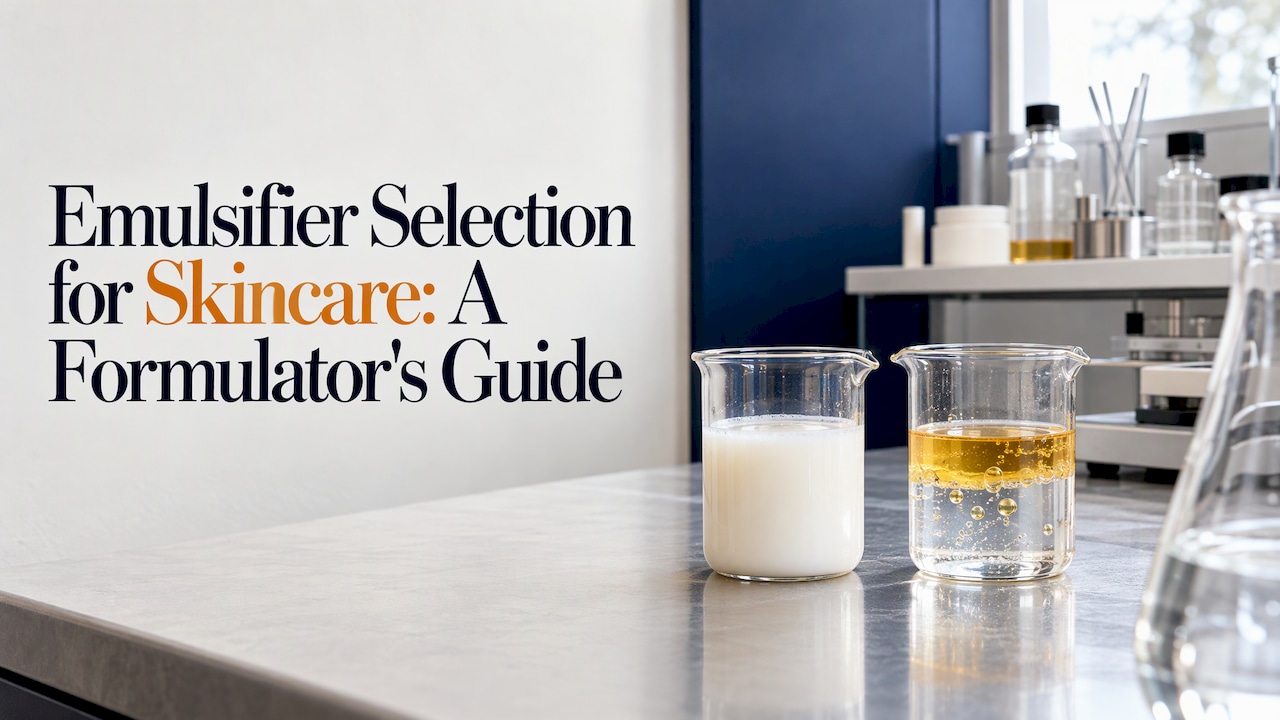
Choose the emulsifier last, not first. Start from the emulsion type you need (oil-in-water or water-in-oil), the oil phase you plan to carry, your active ingredients and the texture you want. Then match an emulsifier whose oil-phase range, HLB, pH range, charge and process needs fit that brief. This guide walks through each decision in order, including natural options and what Singapore brands should check before launch.
TL;DR
- An emulsifier keeps oil and water from separating. Pick it after you have defined emulsion type, oil phase, actives, texture and manufacturing process.
- Compare candidates on oil-phase range, HLB, pH range, charge, shear tolerance and dosage, then confirm by experiment.
- More emulsifier is not automatically better: excess of some surfactants can reduce stability and raise irritation potential.
- Natural emulsifiers such as sucrose esters and lecithin can work well, with antioxidant protection for the oil phase.
- In Singapore, notify the HSA before supplying a cosmetic product, and plan stability testing before you commit to a launch.
Table of Contents
- What an emulsifier does in a skincare formula
- The main types of emulsifier
- How to choose: a step-by-step method
- Process and scale: where lab results meet the factory
- Natural emulsifiers: what works and what to watch
- Skin tolerance: are emulsifiers good or bad for skin?
- Stability testing: proving the choice
- Singapore requirements to keep in view
- Our perspective
- Work with a Singapore formulation team
- A quick selection checklist
- FAQ
- Sources
What an emulsifier does in a skincare formula
Creams, lotions and many serums are mixtures of ingredients that do not want to mix. Emulsifiers help oil and water combine and keep them from separating. Without one, a lotion splits into layers on the shelf. With the wrong one, it may look fine on day one and fail at week six.
The emulsifier also shapes how the product feels. Viscosity, spreadability, afterfeel and how a cream behaves in a humid bathroom all trace back to this choice. That is why experienced formulators treat it as a design decision rather than a line item.
The main types of emulsifier
The most common skincare emulsifiers are grouped by charge: anionic, cationic and non-ionic. In practice, the charge tells you what the emulsifier is compatible with.
| Type | Charge behaviour | Practical consideration |
|---|---|---|
| Non-ionic | No charge | Wide pH tolerance and broad compatibility with actives, so a common starting point |
| Anionic | Negative | Check compatibility with cationic ingredients and the pH range of the system |
| Cationic | Positive | Common in conditioning systems; check against anionic ingredients |
Beyond charge, you will also hear emulsifiers described as O/W (oil-in-water) or W/O (water-in-oil). Which you need depends on the product. Light lotions and gel-creams are usually O/W. Richer, more occlusive products such as some barrier balms and sunscreens are often W/O. Some emulsifier systems are built to form lamellar structures, which suit moisturising creams.
How to choose: a step-by-step method
A formulator choosing an emulsifier should weigh the formulation system, concept, ingredients, desired viscosity and the emulsifier’s own characteristics, then experiment to find a suitable choice. Here is that logic as a working sequence.
1. Decide the emulsion type
First settle whether you need an O/W or W/O emulsifier. This is dictated by the product concept: a fast-absorbing daily moisturiser and a rich night balm call for different systems. Write the target texture down before you open a supplier catalogue.
2. Define the oil phase
Look at the oil phase concentration and composition. A formula with 8% light esters behaves very differently from one with 25% butters and vegetable oils. Check each candidate’s stated oil-phase range against your plan, and note any oils that are hard to emulsify.
3. Use HLB as a guideline
HLB (hydrophilic-lipophilic balance) is a number describing whether an emulsifier leans towards water or oil. Treat it as a guideline, not a guarantee. Higher values generally favour O/W systems and lower values favour W/O, but blends of emulsifiers often outperform a single one matched to a calculated target.
4. Check pH, charge and your actives
List your actives and the pH they need. Then compare with the emulsifier’s pH range and charge. A system that is stable at pH 6 may fall apart at pH 4, which matters if you use acids or certain vitamin C forms. This step is where many prototype failures start.
5. Match the process
The same emulsifier can behave differently depending on how it is made. Emulsion stability and physical properties are affected by mixing intensity, cooling rate and emulsification temperature. If your formula must be made hot, with high shear, check that the emulsifier tolerates it. If you want an energy-saving route, look at emulsifiers designed for cold processing and confirm they suit the oil phase.
6. Set the dosage, then test
Dosage deserves care. Using more surfactant does not always give greater stability or better performance; excessive amounts of some surfactants can reduce stability and shelf life and increase irritation potential. Start from the supplier’s recommended range, run a small matrix of dosages, and keep the lowest level that holds up through testing.
Process and scale: where lab results meet the factory
A beaker batch of 200 g is forgiving. A production batch is not. Heating and cooling times are longer, shear is different, and small differences in addition order show up as viscosity drift. When you choose an emulsifier, ask early whether the lab method can be reproduced on production equipment.
This is one reason brands work with a manufacturer during development rather than handing over a finished recipe. Our own approach to skincare R&D and OEM production keeps formulation and process decisions in the same conversation, so an emulsifier is never chosen without reference to how it will be made.
Natural emulsifiers: what works and what to watch
Many brand owners ask for a natural emulsifier. Several options exist, each with different strengths.
Sucrose esters. These are described as natural, mild emulsifiers that can give good skin feel and improve smoothness, emolliency and moisturisation. The same guide describes them as suitable for traditional and lamellar liquid crystal emulsions.
Lecithin. In one academic study, W/O emulsions made with 4% deoiled lecithin held up to 80% water and stayed stable through two freeze/thaw cycles. That is useful evidence for water-rich W/O designs, though a finished product still needs testing in its own formula.
Protecting the oil phase. Natural emulsifiers often face oxidative stability challenges. Adding an antioxidant such as tocopherol at 0.1 to 0.5% in the oil phase can significantly improve shelf life. Plan this into the formula from the start rather than adding it after a failed test.
When a brief says natural, we clarify what the brand means: a marketing claim, a certification target or simply a gentle feel. Each leads to a different shortlist.
Skin tolerance: are emulsifiers good or bad for skin?
Neither, as a blanket statement. Tolerance depends on the specific emulsifier, the dose and the finished formula. A professional review notes that some emulsifiers, including certain short-chained anionic combinations, may cause skin irritation and affect the skin barrier. It also describes a wash-out effect, in which protective skin substances can be carried out of the skin, especially on contact with water.
The practical lesson for formulators is to choose emulsifiers with the target user in mind. A rinse-off cleanser, a leave-on moisturiser for sensitive skin and a clinic-grade formulation each deserve a different selection, and the lowest effective dose. For products aimed at reactive skin, ask a dermatologist or the clinic’s medical lead to review the concept.
Stability testing: proving the choice
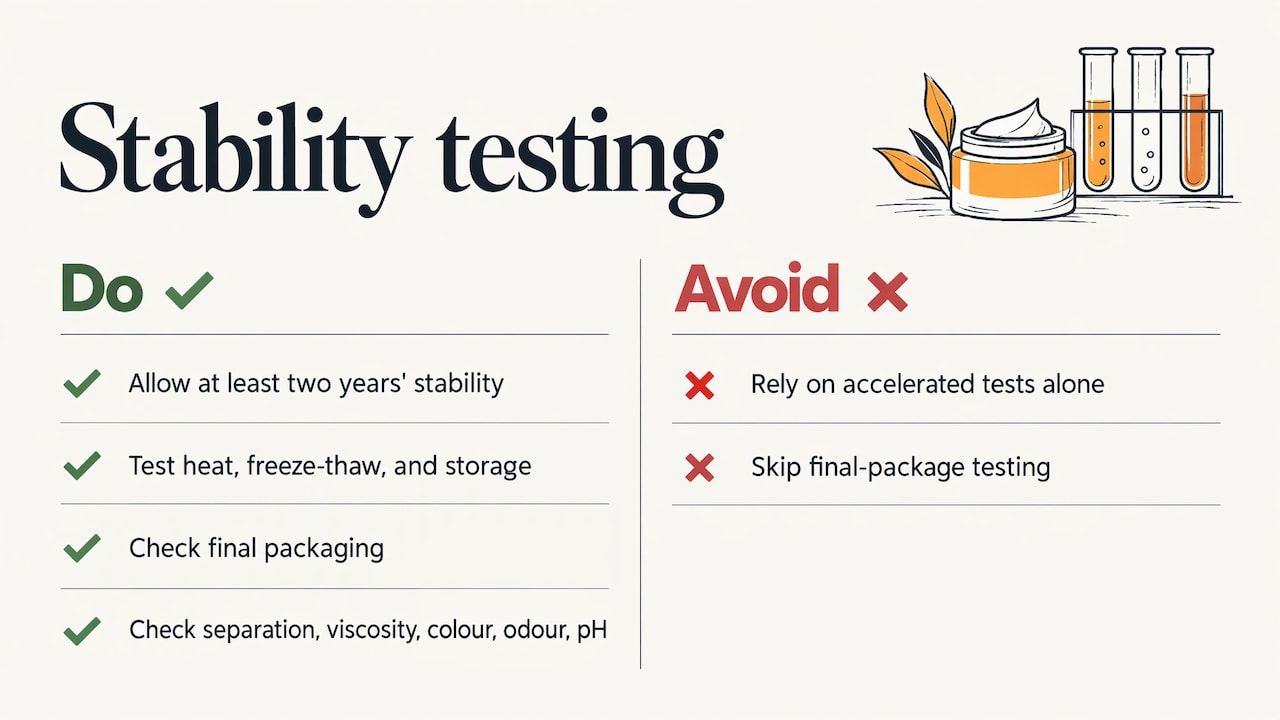
The emulsifier is only right if the product stays right. Most commercial cosmetic emulsions need a minimum of two years’ stability. Accelerated tests in varying environments are useful, but they are not completely reliable unless enough time is allowed.
A sensible programme includes elevated temperatures, freeze-thaw cycles and extended storage. Watch for separation, viscosity change, colour and odour shift, and pH drift. Test in the final packaging as well, because the container affects the result. For more on this, see our pieces on why stability testing matters and cosmetic stability testing for lasting products.
Singapore requirements to keep in view
Emulsifier choice also has a regulatory side. Singapore’s rules restrict the use of listed substances in cosmetic products, subject to specified exceptions and conditions, so every ingredient in your shortlist, emulsifier included, should be checked against the current schedules before you lock the formula.
Anyone placing a cosmetic product on the local market must notify the HSA before supply or sale. Notification is submitted online through PRISM, and the product may be supplied after acknowledgement. The same source notes that Singapore does not require a manufacturer’s licence for cosmetics, while manufacturers may voluntarily apply for GMP certification to align with international standards and support exports.
Keep your product claims within cosmetic territory as well. For background on how regulators separate approved medicines from other categories, see this overview of drug approval and RUO materials. Our guides cover the details for Singapore: HSA cosmetic notification, the ASEAN Cosmetic Directive and GMP in cosmetics.
Our perspective
In our experience, brands lose the most time when the emulsifier is picked from a supplier brochure before the product concept is settled. We prefer to work the other way round: agree the texture, the actives, the skin type and the target market, then build the emulsifier system around them.
That is why we put collaboration with the client at the centre of development. Our R&D process is designed to match the formula to your market trends and customer needs, and our GMP certification from Singapore’s HSA reflects the quality standards we apply when a formula moves into production.
We also believe in using high-quality, safe ingredients and testing a formula properly before it ships. Whether the product is for home use, a professional salon or a medical formulation, the emulsifier decision is where good development shows.
Edmund
Work with a Singapore formulation team
If you are developing a cream, lotion or serum and want the emulsifier system designed around your brief, our team handles custom formulation, R&D, quality control and packaging for private label, salon and medical skincare lines. See our OEM and ODM services or start with the skincare product development service.
Tell us the product type, target skin and market, and we will take it from there. You can also browse our product lines or read the seven steps to launch a private label range in Singapore.
A quick selection checklist
Before you commit to an emulsifier, confirm each point on paper:
- Emulsion type (O/W or W/O) and target texture are written down.
- Oil phase percentage and composition fit the emulsifier’s stated range.
- HLB is used as a guide, and blends have been considered.
- pH range and charge are compatible with every active.
- The process (temperature, shear, cooling) matches what production equipment can do.
- Dosage has been tested at several levels, with the lowest stable one chosen.
- Antioxidants are included where natural emulsifiers or oxidation-prone oils are used.
- Every ingredient is checked against Singapore’s current restrictions, and the HSA notification is planned.
FAQ
What are some types of emulsifiers?
Skincare emulsifiers are commonly grouped as anionic, cationic and non-ionic according to their charge. They are also described as O/W or W/O depending on the emulsion they create. Natural options include sucrose esters and lecithin.
Are emulsifying agents good or bad for you?
It depends on the emulsifier, the dose and the formula. Some, including certain short-chained anionic combinations, may irritate skin or affect the barrier, so selection and dosage matter. If you have reactive or medically managed skin, check a product with your dermatologist.
Is more emulsifier better for stability?
Not necessarily. Excess of some surfactants can reduce stability and shelf life and raise irritation potential. The aim is the lowest level that stays stable through testing.
Do I need HSA approval for a skincare product in Singapore?
You need to notify the HSA before supplying or selling a cosmetic product, which is done online through PRISM. The product can be supplied after acknowledgement. Check the HSA’s current guidance for the latest requirements.
Sources
- What Are the Types of Emulsifiers in Skincare?
- 17 Points to Consider Before Choosing an Emulsifier
- Solving Manufacturing Problems in Emulsion Products
- Sisterna Formulation Guide 2026
- Rheology and stability of phospholipid-stabilized emulsions
- Natural Emulsifiers: HLB Values, Usage Levels and Comparison
- Formulation Design of Emulsion-Based Cosmetic Systems
- Health Products (Cosmetic Products, ASEAN Cosmetic Directive) Regulations
- Singapore Cosmetic Regulation
- Emulsifiers in skin care: Purposes, Properties and Effects