Sourcing cosmetic ingredients well comes down to four things. Specify each material precisely, qualify the supplier against that specification, check it against Singapore’s ASEAN-based rules, and plan a backup before you need one. Brands that skip these steps tend to find the problem late, when a batch drifts, a lead time stretches or a regulator asks for paperwork. This guide walks through each step for Singapore brands, salons and clinics building a skincare line.
TL;DR
- Specify every ingredient beyond its marketing name: INCI name, CAS number, grade, assay basis, origin and manufacturing site.
- Treat supplier choice as a qualification exercise per project, not a catalogue price comparison.
- In Singapore, ingredients must fit the ASEAN Cosmetic Directive annexes, and your Product Information File must hold raw material specifications and certificates of analysis.
- Name a qualified alternative for every critical ingredient before launch, and define what the substitute must preserve.
- A manufacturing partner with GMP certification can take much of the sourcing and documentation work off your hands.
Table of Contents
- What ingredient sourcing actually involves
- Step 1: write the specification before you search
- Step 2: find and assess raw material suppliers
- Step 3: verify origin, traceability and credentials
- Step 4: check Singapore’s rules before you commit
- Step 5: manage supply risk before it happens
- A worked example: sourcing for a first serum
- Doing it yourself or through a manufacturer
- Work with a manufacturer that sources with you
- FAQ
- Sources
What ingredient sourcing actually involves
Sourcing is more than finding a cheaper price for the same name on a label. It covers deciding what you need, finding who can make it consistently, proving it is safe and legal for your market, and keeping it flowing batch after batch.
For a brand owner, the hard part is that two materials can carry the same INCI name and behave differently. Grade, purity, extraction method, particle size and the manufacturing site all change how an ingredient performs in your formula and what paperwork comes with it. That is why the first job is a written specification, not a supplier shortlist.
Step 1: write the specification before you search
A purchase order that says “glycerin” invites trouble. A useful specification names the CAS number, the purity grade (for example, pharmaceutical-grade glycerin at 99.5% minimum versus cosmetic grade at 98% minimum), physical properties such as viscosity, pH and colour, the exact INCI name for the label, the contents you expect on the certificate of analysis (heavy metals, pesticide residues, microbial limits, impurity profile) and any certifications you need. One procurement guide lays out this checklist for buyers.
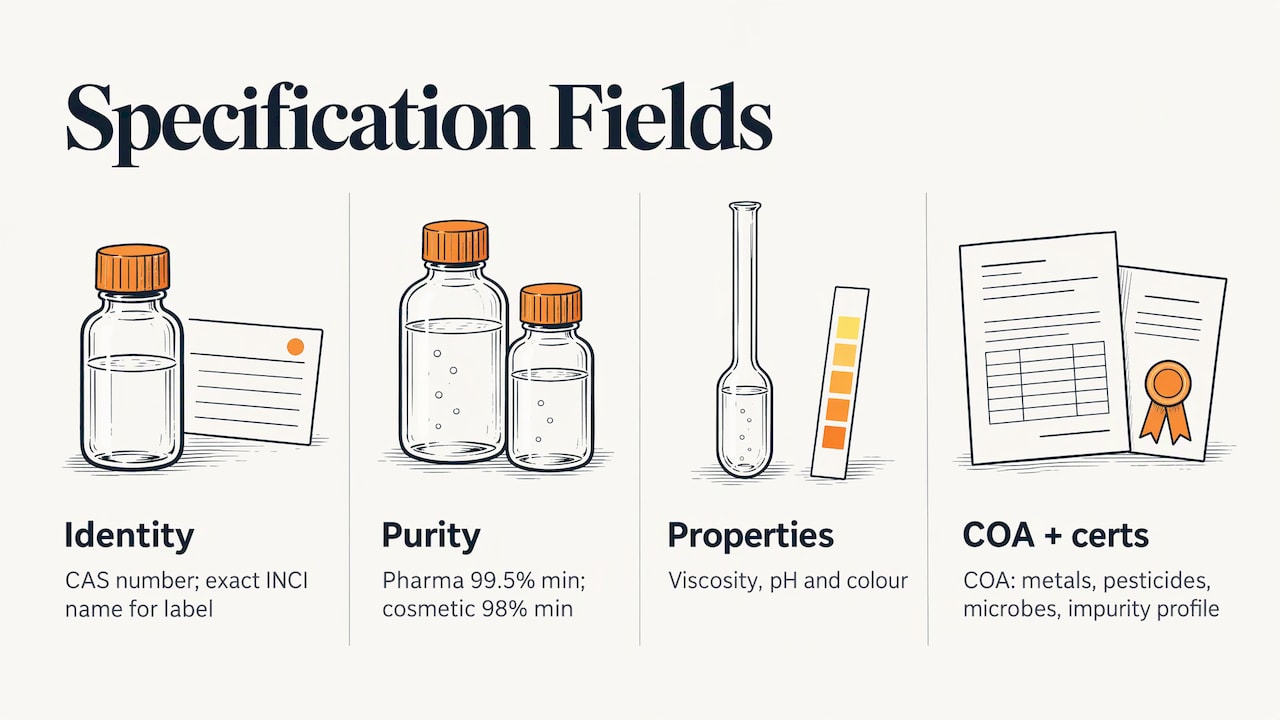
For botanical and complex materials, go further. A supplier qualification checklist recommends combining INCI or common name with CAS or EC numbers, grade and intended cosmetic function, the composition or assay basis, and the origin and manufacturing site. The more specific the combination, the lower the risk of receiving something that matches on paper but not in the tank.
A specification sheet you can reuse
For each raw material, keep one file. A practical supplier-file list includes:
- trade name, supplier and manufacturing site
- INCI name and full composition or subcomponent statement
- technical data sheet and specification
- current certificate of analysis
- safety data and recommended use range
- solubility, pH, heat and shear constraints
- microbiological limits, preservatives and allergens
- evidence package tied to the exact branded material
- regulatory or certification statements for your target markets
- MOQ, lead time, price basis and a qualified alternative
This file does double duty. It guides your formulator, and it feeds the documentation you must hold for HSA.
Step 2: find and assess raw material suppliers
Cosmetic raw material suppliers fall into a few types: producers of the material, distributors and traders who hold stock locally, and specialist houses for botanicals, actives, fragrances or colours. Each has a place. Producers can offer the deepest technical data and change control. Distributors give you smaller quantities and shorter lead times, which matters for a first production run.
Qualify against your project, not against a brochure. The same checklist approach treats supplier qualification as project-specific: you test the supplier against the identity, documentation, change control and traceability needs of what you are actually making.
Questions worth asking every supplier
- Who manufactures the material, and at which site?
- Will you notify us before changing the process, the raw materials behind it or the site?
- Can you supply a current certificate of analysis for every lot, and a safety data sheet?
- What are the minimum order quantity and the realistic lead time?
- Can you provide documents for ASEAN-aligned product files, such as specifications and microbiological and chemical purity criteria?
- What certifications and regulatory statements can you back with paperwork?
A supplier who answers these promptly and in writing is usually one who will also answer when something goes wrong. Vague answers on site, change control or lot records are a signal to look elsewhere.
Our own view on how suppliers affect the outcome of a launch is covered in how cosmetic suppliers shape product success.
Step 3: verify origin, traceability and credentials
Claims such as “natural”, “sustainably sourced” or “ethically harvested” are only as good as the paperwork behind them. Before you repeat one on a label or a website, ask for the evidence in a form you can file.
Practical ways to check:
- Ask for the chain, not just the last link. For a botanical, request the species, country and region of origin, the part of the plant used and the processing steps up to your supplier.
- Match certificates to the exact material. A certification held by a company or a site does not automatically cover every product it sells. Ask which products and which lots the certificate covers, and check its validity dates with the issuing body.
- Keep lot-level records. Tie each incoming lot number to its certificate of analysis and to the batch of your finished product it went into.
- Match the claim to the evidence. If you plan to market a sourcing or sustainability claim, see our guide to cosmetic claims substantiation so that the proof exists before the claim is printed.
Lot-level records also help in Singapore for a legal reason: companies must keep supply records for two years, as set out in the next section.
Step 4: check Singapore’s rules before you commit
Ingredient choice is not only a commercial decision here. Singapore implemented the ASEAN Cosmetic Directive (ACD) from 1 January 2008, and HSA’s ACD page lists the annexes that govern ingredients. They cover prohibited substances (Annex II), restricted substances (Annex III), permitted colouring agents (Annex IV), allowable preservatives (Annex VI) and permitted UV filters (Annex VII), alongside documentation and GMP guidance.
The restricted list is where formulas most often need adjusting. According to the ASEAN general information booklet, it sets the maximum authorised concentration, the field of application and the labelling conditions for each restricted ingredient. So a material that is fine at one level in a body oil may need a different limit or a warning in a leave-on face product.
What HSA expects you to keep
Under HSA’s notification system, each notification is valid for one year and must be renewed annually. Companies must keep supply records for two years and submit safety and technical information to HSA when asked. Our walkthrough of the HSA cosmetic notification process and the wider ASEAN Cosmetic Directive covers the practical side.
The Product Information File is where your sourcing paperwork lands. The ASEAN PIF guidelines state that it must include:
- the qualitative and quantitative composition of the product
- specifications of raw materials and the finished product
- methods of manufacture that comply with GMP
- safety assessment information for human health, including data on undesirable effects
They also call for the method of analysis used to check ingredients against the certificate of analysis, and the criteria for microbiological control and chemical purity. In plain terms: if your supplier cannot give you a specification and a certificate of analysis, you cannot build a complete file.
For how GMP fits in, see GMP in cosmetics and what Singapore expects.
Step 5: manage supply risk before it happens
The usual sourcing problems are inconsistent quality between lots, shortages, stretched lead times and moving costs. You cannot remove them, but you can decide in advance how you will react.
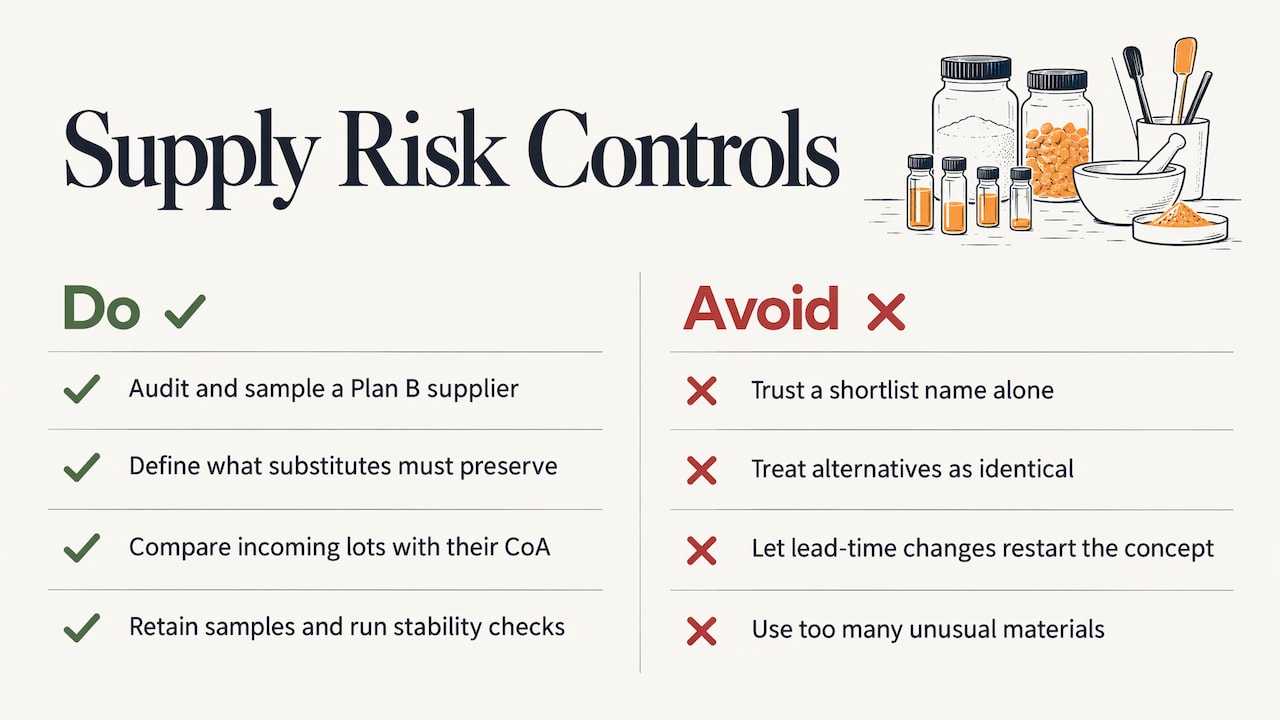
Qualify a Plan B. One useful test is whether a qualified alternative could ship in time for next month’s production run if the main input disappeared tomorrow. A name on a shortlist does not pass that test. A supplier you have already audited on paper and sampled does.
Define what a substitute must preserve. Alternatives are not identical, so write down the active marker, solubility, sensory profile, provenance, documentation, cost range or claim relevance that the replacement has to match. Then a change in lead time becomes a controlled decision instead of a restart of the whole concept.
Test what arrives. Compare each incoming lot with its certificate of analysis, keep retained samples, and run stability checks when you change a material. Our stability testing and QC services page explains what this involves.
Limit the number of critical inputs. The fewer unusual materials in a formula, the fewer single points of failure. A formulator who knows what is reliably available can often reach the same texture and performance with a simpler ingredient list.
A worked example: sourcing for a first serum
Imagine a founder planning a hydrating serum for the Singapore market. A sensible order of work looks like this.
- Draft the brief: skin concern, texture, target price band, claims you want to make, and any ingredients you want or want to avoid.
- List the functional ingredients (humectant, active, preservative system, thickener) and write a specification for each, with INCI name, grade and expected certificate content.
- Screen each against the ACD annexes: is it prohibited, restricted, or limited to certain concentrations or uses? Is the preservative on the permitted list?
- Request samples and documents from at least two suppliers per critical ingredient, and record MOQ, lead time and price basis.
- Build pilot batches and stability-test them. Only then lock the supplier list.
- Assemble the Product Information File and submit the HSA notification.
Notice that supplier prices appear at step 4, not step 1. Brands that start with price often end up re-formulating when a cheap material fails a limit or a stability test.
Doing it yourself or through a manufacturer
A brand can buy raw materials directly and hand them to a contract filler, or it can have its manufacturer source them as part of development. Direct buying gives you control but puts every specification, certificate and qualification on your desk. Using the manufacturer’s sourcing puts that work inside a quality system.
Our perspective
Most sourcing problems we see start before any supplier is contacted: the ingredient was never properly specified, or the formula was written without asking whether the materials would be available in steady quality. We approach it the other way round. Our R&D team works with you on the brief, the market and the target user, then formulates around ingredients that can be documented, are suitable for Singapore’s rules and can be supplied consistently.
As a GMP-certified OEM/ODM manufacturer in Singapore, we handle formulation, quality control and packaging under one roof, so the specification, the certificate of analysis and the finished-batch record belong to the same system. That makes the Product Information File far easier to assemble, and it means a change in an input is a conversation with your development team, not a surprise on the filling line.
Whether your line is for home use, a professional salon or a medical practice, the principle is the same: know exactly what is in the tank, and why.
Edmund
Work with a manufacturer that sources with you
If you would rather not run supplier qualification yourself, we can carry it as part of skincare R&D and manufacturing, from formulation through quality control to packaging. We make private label, professional salon and aesthetic or doctor’s formulation lines, and you can see the ranges on our products page.
To see how a project runs from brief to launch, read our skincare launch roadmap, or start with custom cosmetic formulation. If you are still comparing manufacturers, nine questions to ask before choosing a skincare manufacturer is a useful checklist.
FAQ
Where can I find cosmetic raw material suppliers in Singapore?
Start with producers’ own technical sales teams, local distributors that hold stock, and specialist houses for botanicals, actives and fragrances. Ask each for a specification, a current certificate of analysis and the manufacturing site. A manufacturing partner can also source on your behalf as part of development.
What documents should a supplier give me?
At minimum: a specification, a lot-specific certificate of analysis, a safety data sheet and the INCI name with full composition. You also need data that supports the Product Information File, including raw material specifications and microbiological and chemical purity criteria, as the ASEAN PIF guidelines describe.
Which ingredients are restricted in Singapore?
Singapore follows the ASEAN Cosmetic Directive annexes, which list prohibited substances, restricted substances with conditions, and permitted colourants, preservatives and UV filters. Check each ingredient against them, including concentration limits and labelling conditions, before you finalise a formula.
How long must I keep ingredient and supply records?
HSA states that companies must keep supply records for two years and provide safety and technical information when requested. Keeping lot-level records of incoming materials, linked to finished batches, makes this straightforward.
Do I need a backup supplier?
For any critical ingredient, yes. Qualify an alternative in advance and write down what it must match in performance, documentation and cost, so a shortage does not stall your production run.
Sources
- ASEAN Cosmetic Directive, Health Sciences Authority
- Submit notification and re-notification, Health Sciences Authority
- ASEAN Guidelines for the Product Information File
- General Information Booklet on the ASEAN Harmonised Cosmetic Regulatory Scheme
- Chemical Sourcing for Personal Care and Cosmetics, procurement guide
- Cosmetic Ingredient Supplier Qualification: A Buyer’s Checklist
- Cosmetic Ingredient Specifications Beyond INCI
- Building Resilient Supply Chains for Natural Products