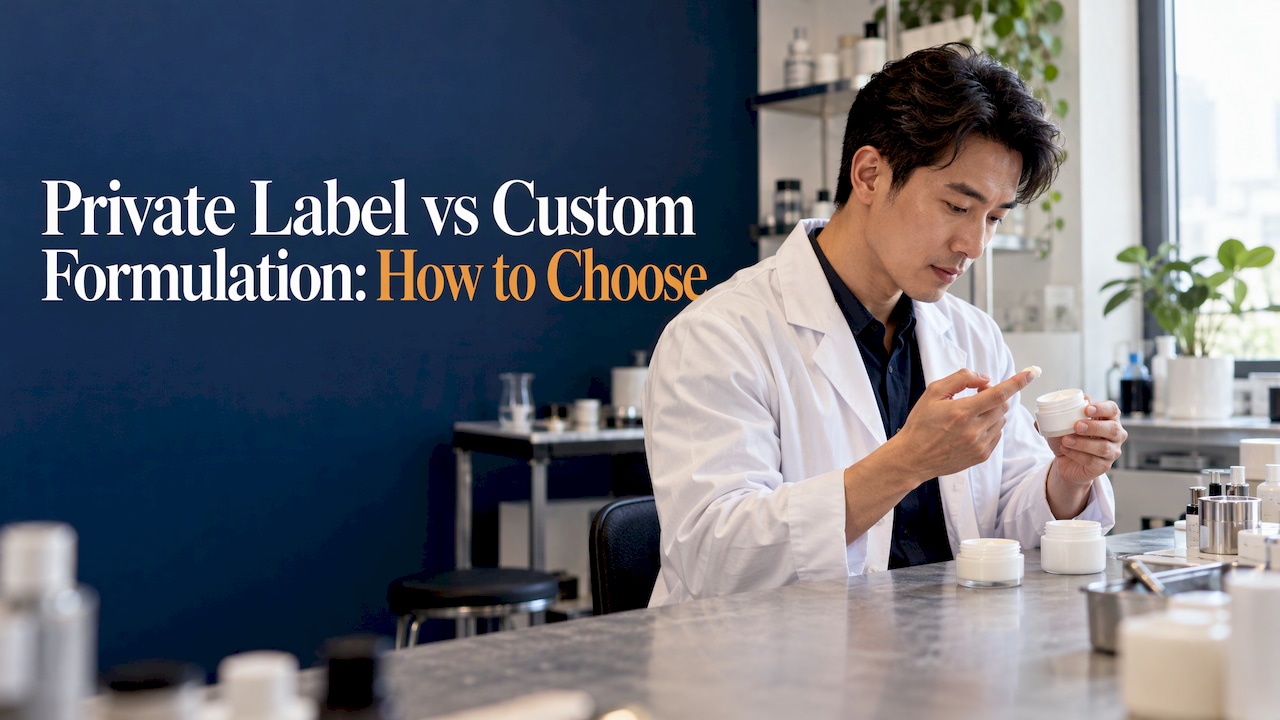
Private label means you pick a formula the manufacturer has already developed and put your brand on it. Custom formulation means the manufacturer develops a formula for you, to your brief. The first is faster and lighter on development work. The second gives you a product built around your concept and a stronger case for differentiation. Neither is automatically better: the right choice depends on how soon you need to launch, how distinctive the product must be, and how much development work you are ready to fund.
This guide sets the two routes side by side for a skincare brand being launched or extended in Singapore. It also covers where “contract manufacturing” fits, who controls the formula, and what the Health Sciences Authority (HSA) expects whichever route you take.
TL;DR
- Private label: you choose an existing base formula, then customise scent, texture within the range offered, packaging and branding. It suits a faster, lower-risk first launch.
- Custom formulation: a formula is developed to your brief, which suits a hero product, a specific skin concern, or a professional or clinic line.
- Contract manufacturing describes who makes the product, not how the formula is created. Both routes can be contract manufactured.
- Exclusivity is never automatic. Whether a formula is yours alone, and whether you can move it to another factory, must be written into the contract.
- In Singapore, the rules are the same on both routes. Each variant must be notified to HSA before it is supplied, and the seller carries the safety responsibility.
Table of Contents
- What private label means in skincare
- What custom formulation means
- Side-by-side comparison
- Where contract manufacturing fits
- Who owns the formula, and does custom mean exclusive?
- Singapore rules apply on both routes
- How to choose: a practical decision guide
- Questions to put to any manufacturer
- Perspective
- Working with Harmony Skin Lab
- FAQ
- Sources
What private label means in skincare
In a private label arrangement, the manufacturer holds a catalogue of formulas it has already developed, stability-tested and produced. You select one, choose your packaging, add your name and artwork, and the factory fills and ships it. Your brand is on the front, but the recipe behind it started life as the manufacturer’s own.
Typical things you can adjust are the fragrance, the colour, the pack format, the label and the carton. Some manufacturers also allow small tweaks, such as adding an active within a tested range. The base itself stays the manufacturer’s.
That has two practical consequences:
- You skip most of the development stage. There is no brief to write, no round of sample revisions and no from-scratch stability programme for the base.
- Other brands may sell something close to yours. If several customers draw from the same catalogue, differentiation has to come from branding, claims you can support, and the experience you wrap around the product.
If you are starting from nothing, our walkthrough on how to start a private label skincare brand covers the early decisions, and 10 private label skincare options for startup brands shows what product types are usually available.
What custom formulation means
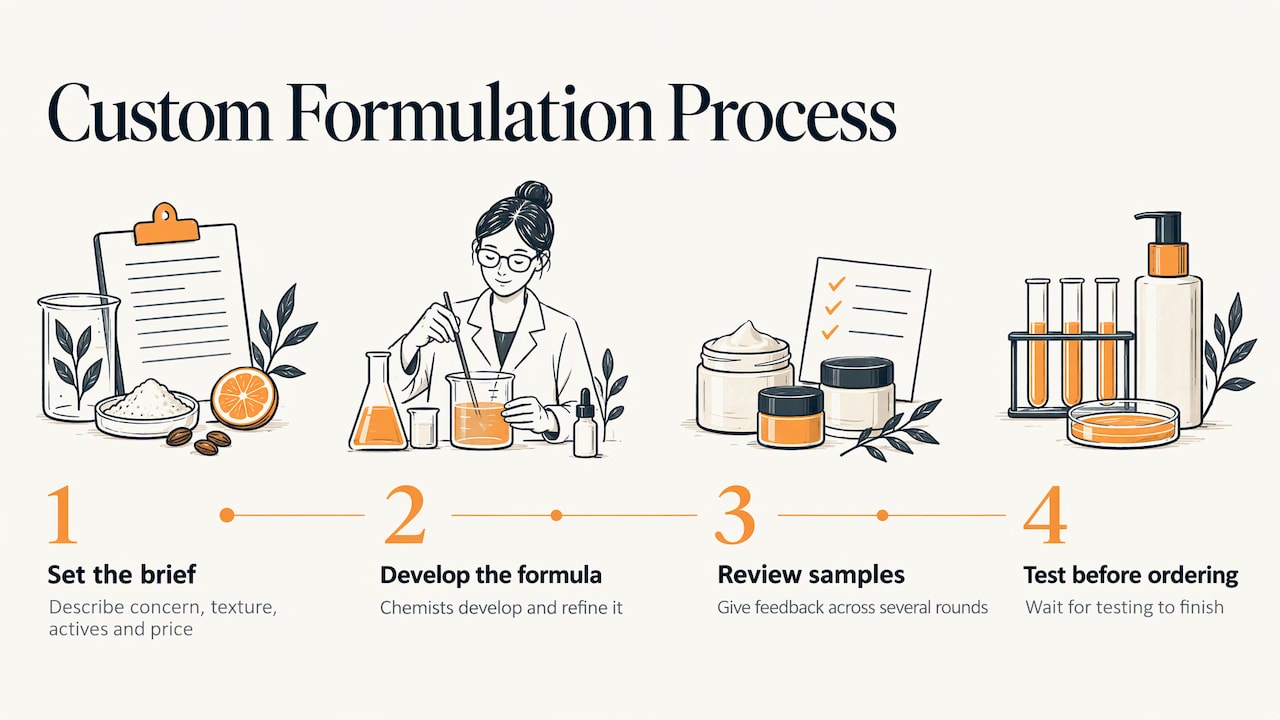
Custom formulation starts from your brief rather than from a catalogue. You describe the product: the skin concern, the texture, the sensory feel, the actives you want, the price position, the claims you hope to make. Chemists then develop and refine a formula, usually through several sample rounds, and the result is tested before it goes into production.
The difference you feel is control. You decide the character of the product, and you can build a story around it that a catalogue formula cannot support. The trade-off is that you take part in the process: you review samples, give feedback, and wait for development and testing to finish before you can order.
If you want to understand what that process involves, see how to develop a skincare formulation that sells and custom cosmetic formulation for brand growth.
Side-by-side comparison
| Factor | Private label | Custom formulation |
|---|---|---|
| Starting point | Existing formula from the manufacturer’s range | Your brief, developed from scratch |
| What you customise | Scent, colour, packaging, branding, sometimes small tweaks | Actives, texture, sensory feel, performance targets, packaging, branding |
| Development effort from you | Light: choose, approve samples | Heavier: brief, sample feedback, revisions |
| Time to first order | Shorter | Longer, because development and testing come first |
| Upfront cost | Generally lower | Generally higher, because development is paid for |
| Product differentiation | Mostly brand-led | Formula-led and brand-led |
| Formula ownership | Usually stays with the manufacturer | Negotiable, and should be agreed in writing |
| Best for | First launches, testing a market, filling out a range | Hero products, specific concerns, salon, clinic and medical lines |
The table deliberately gives no fixed prices or weeks. Minimum order quantities, development fees and lead times differ by product type (a cleanser is not a serum, and an oil is not an emulsion), by packaging and by the manufacturer. Ask for them in writing against your specific product, and treat any universal figure with suspicion.
Where contract manufacturing fits
Readers often set “private label” against “contract manufacturing” as though they were opposites. They are not, because they answer different questions.
- Private label and custom formulation describe where the formula comes from: a ready one or a new one.
- Contract manufacturing describes who makes the product: a factory produces it for your brand under contract, rather than you owning the plant.
So a private label product is made by a contract manufacturer, and so is a custom formulated one. In the industry you will also see the terms OEM (the factory produces to your specification) and ODM (the factory designs and develops, and you brand the result). Those labels overlap with the two routes here: custom work sits closer to OEM, while choosing from a manufacturer’s own designs sits closer to ODM. Because usage varies between companies, do not rely on the label. Ask the manufacturer to write down who develops the formula, who owns it and who may use it.
Who owns the formula, and does custom mean exclusive?
This is the question that causes the most disputes, and the honest answer is that it depends on the contract.
- Private label: the formula normally remains the manufacturer’s, and it may supply the same or a similar base to others.
- Custom formulation: being developed for you does not by itself mean it is exclusive to you, and it does not by itself mean you can take it elsewhere. Those are separate terms.
Before signing, get answers to these in writing:
- Who owns the formula and the development documents?
- Will the manufacturer supply the same formula, or a close variant, to anyone else, and for how long is that restricted?
- If you want to move production to another factory, will the full formula and process be handed over, and at what cost?
- Who holds the safety assessment and stability data, and will you receive copies?
- What happens to the formula if the relationship ends or either party closes?
If you intend to build a long-term brand on one product, transfer and exclusivity terms matter more than the headline price.
Singapore rules apply on both routes
Choosing a route changes how the product is developed. It does not change the regulation around it. HSA states that notification is generally required before a cosmetic is supplied in Singapore, that it is renewed annually, and that notification is not approval. The seller is responsible for safety and quality, must keep supply records for two years, provide technical information on request, report adverse events and recalls, and recall products with safety concerns.
Two points surprise private label buyers in particular:
- Someone else’s notification does not cover you. HSA requires notification even when another company has already notified the same product, so a catalogue formula still needs your own notification under your name.
- Variants count. Each variant, such as a different scent, needs notification, while different pack sizes alone do not. A range of three fragrances on one base is three notifications.
HSA’s regime follows the ASEAN Cosmetic Directive, implemented in Singapore on 1 January 2008, and dealers are legally responsible for safety, labelling and ingredient restrictions. Check ingredients and labelling against the directive before you notify. Our guides on the HSA cosmetic notification process and the ASEAN Cosmetic Directive go through this step by step.
Labels must be in English and, according to HSA’s regulatory overview, state the product name and function, directions, a full ingredient list, country of manufacture, the responsible local company’s name and address, contents, batch number, manufacturing or expiry date, and any precautions. On a private label product, that responsible local company is normally you, so your name and address go on the pack.
Documentation you should expect
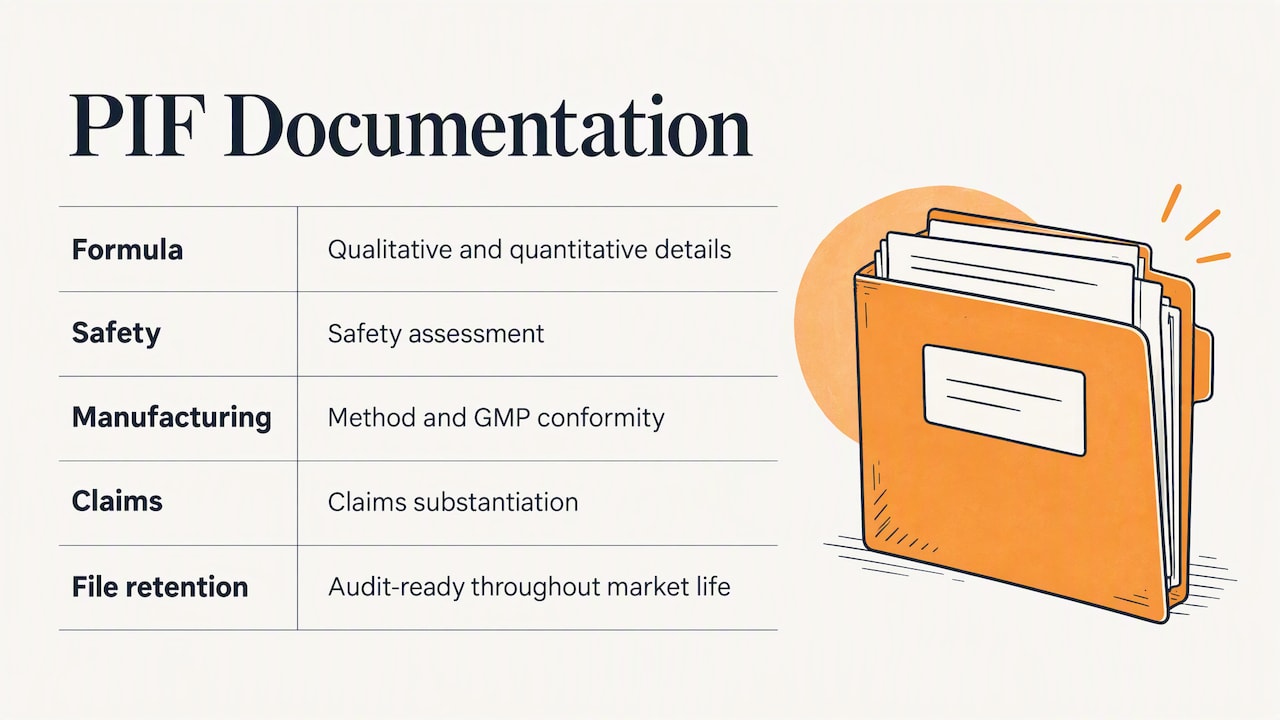
Under the ASEAN framework the responsible company keeps a Product Information File (PIF). Industry guidance describes it as covering the qualitative and quantitative formula, safety assessment, manufacturing method, GMP conformity and claims substantiation, and as a file to keep audit-ready for the product’s whole life on the market. This is where the two routes differ in practice. With custom work, ask what documents you will receive and in what form. With private label, ask what the manufacturer can supply on the base formula and what you must add for your own claims. Either way, agree this before production, not after a query arrives.
Does your manufacturer need GMP?
HSA says Singapore cosmetic manufacturers do not need a manufacturing licence, but can obtain GMP certification voluntarily, with HSA auditing against ASEAN cosmetic GMP guidance. A GMP certificate is therefore a quality signal you can ask to see, and it is worth asking for because it shows the plant has been audited against a recognised standard. More on this in GMP in cosmetics: what Singapore expects and 8 benefits of a GMP skincare manufacturer in Singapore.
How to choose: a practical decision guide
Lean towards private label when:
- this is your first product and you want to test demand before investing in development;
- your edge is brand, distribution or audience rather than a unique formula;
- you need a basic, well-understood product such as a gentle cleanser, a moisturiser or a massage oil;
- you want fewer decisions and a lighter regulatory workload on the formula itself.
Lean towards custom formulation when:
- the product itself is your selling point, for example a particular texture, a targeted concern or a distinctive ingredient story;
- you run a salon or clinic and need a line that matches your treatment protocols, which is the case for professional and aesthetic lines;
- you want to control the ingredient list for positioning reasons, such as a clean or sensitive-skin proposition;
- you plan to scale and want to negotiate formula rights from the start.
A middle path: many brands launch with a private label base to get to market, learn what customers respond to, and then commission a custom version of the best seller. Raise this at the start, since it shapes how you structure the first agreement. If you would like a roadmap for that sequence, our skincare launch roadmap and 7 steps to launch private label cosmetics in Singapore lay it out.
A worked example
Two hypothetical buyers show how this plays out. A beauty therapist with a loyal client base wants a take-home moisturiser and cleanser to sell alongside her treatments. Her clients already trust her, so a private label base with her branding and her choice of fragrance gets her selling soon, and she can learn which product moves.
A clinic owner wants a post-procedure serum shaped around the protocols his practitioners use. The formula is the point, and he wants to be sure no one else sells it. He should commission a custom formulation and negotiate exclusivity, documentation and transfer rights in the same contract.
Questions to put to any manufacturer
Whichever route you favour, ask these before you commit. Our list of 9 questions before choosing a skincare manufacturer goes deeper.
- Can you show me a written scope that says what is catalogue and what is customised?
- What is the minimum order quantity for each pack size, and does it change for variants?
- What stability and safety documentation will I receive?
- Do you hold GMP certification, and can I see it?
- Who is the responsible company on the label and in HSA notification?
- What are the terms on exclusivity, formula ownership and transfer?
- What does packaging, filling and finishing cost, and is any of it handled in-house?
A sound manufacturer answers these plainly. Vague answers on ownership or documentation are a reason to keep looking.
Perspective
Most brands that come to us ask the question in the wrong order. They ask which route is cheaper, when the better question is what the product must do for the brand. If the answer is “get to market and learn”, a well-chosen starting formula is a sensible first step. If the answer is “be something nobody else has”, the formula has to be built for you.
This is why we work as a collaborator rather than a catalogue. We are a GMP-certified OEM and ODM skincare manufacturer in Singapore, and we treat research and development as a conversation with the client about market trends, skin needs and the customers they want to reach. That applies to home-use lines, professional salon ranges and aesthetic or doctor’s formulations alike.
Our advice is to decide on exclusivity and documentation on day one, whichever route you choose, and to pick a partner who will talk about them openly.
Edmund
Working with Harmony Skin Lab
Harmony Skin Lab handles skincare R&D and manufacturing, design and packaging, filling and distribution under one roof in Singapore. That includes sachet packaging and filling, product filtration and cellophane wrapping. Our product lines cover home-use essential skincare, professional salon skincare, aesthetic and doctor’s formulations, and massage and essential oils. Whether you want to start from an existing direction or develop something of your own, we can talk through your brief and what each route involves for your product.
See our skincare product development service or browse the full list of services and tell us about your project.
FAQ
Is private label the same as white label?
The two terms are often used interchangeably, but some manufacturers separate them. White label usually means a ready-made product sold to several brands with only the label changed, while private label allows more adjustment, such as fragrance and packaging. Because usage varies, ask what is customisable in writing rather than relying on the term.
Can a custom skincare product be contract manufactured?
Yes. Contract manufacturing means a factory produces the product for your brand, so it applies to private label and custom formulated products equally. The real questions are who develops the formula, who owns it and whether you can move production later.
Do I still need HSA notification for a private label product?
Yes. HSA requires notification before a cosmetic product is supplied in Singapore, including when another company has already notified the same product, and each variant such as a different scent needs its own notification. Notification is renewed annually, and the HSA notification page has the current process.
Does custom formulation guarantee exclusivity?
No. Exclusivity, formula ownership and the right to transfer production are contract terms, not automatic results of custom development. Negotiate each one separately and have it written down before development starts.
Which route suits a salon or clinic?
A salon wanting a branded retail range can start with private label, while a clinic needing a formula that matches its protocols usually benefits from custom work. Read more on professional salon skincare manufacturing and aesthetic skincare for clinics in Singapore.
Sources
- Submit notification and re-notification, Health Sciences Authority
- Regulatory overview of cosmetic products, Health Sciences Authority
- ASEAN Cosmetic Directive, Health Sciences Authority
- Good Manufacturing Practice certification for cosmetics, Health Sciences Authority