Retinol encapsulation means enclosing the retinol in microscopic protective carriers, such as liposomes or solid lipid particles, so it resists light, air and heat and is released gradually on the skin. For a brand, the point is simple: a more stable active and a formula that is designed to be gentler. But encapsulation only pays off when the carrier, the base, the packaging and the stability programme are chosen together.
This guide is written for founders, salon owners and clinic professionals who are planning a retinol product. It explains the mechanism, the evidence, the formulation variables and the testing that decides whether the product still works in month 18.
TL;DR
- Encapsulation wraps retinol in a protective carrier that shields it from light, oxygen and heat and releases it over several hours.
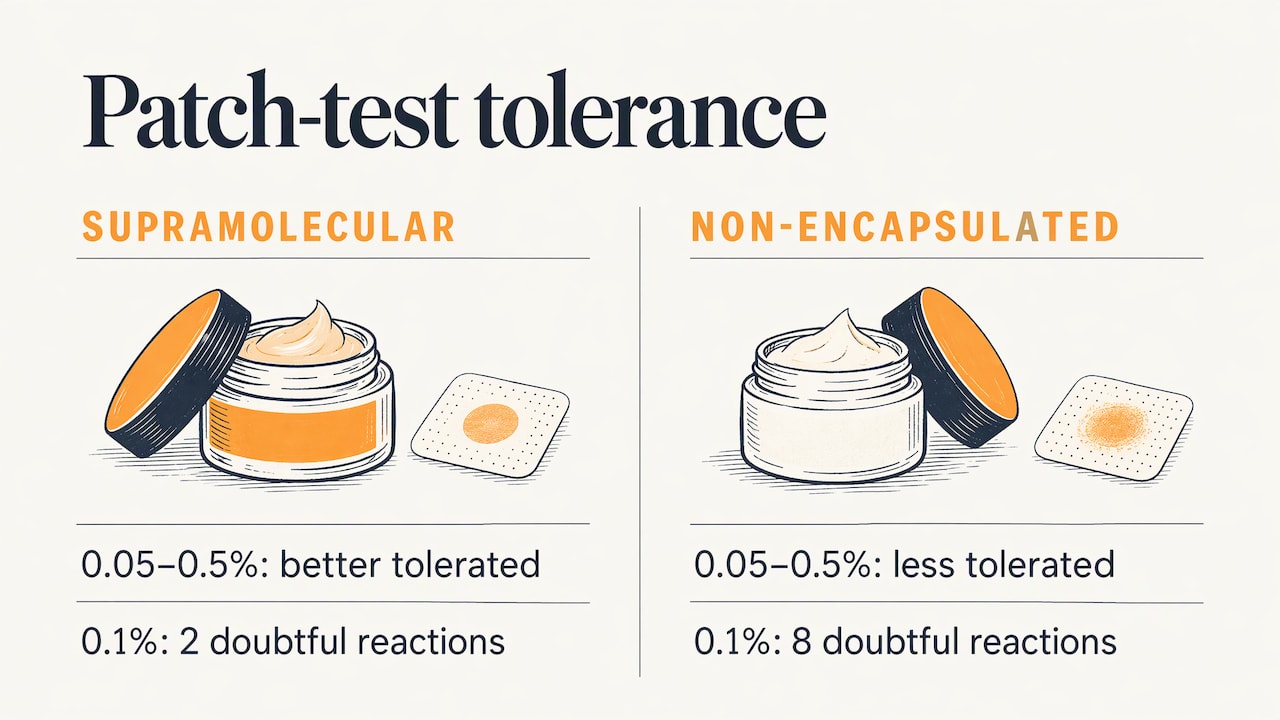
- In one patch test of 32 subjects, encapsulated (supramolecular) retinol caused fewer doubtful reactions than the non-encapsulated form at 0.1%.
- Carrier type, pH, antioxidants, chelators, processing temperature and packaging all shape the final stability. The carrier alone does not guarantee it.
- Encapsulated retinol is a cosmetic precursor, not tretinoin. Skin has to convert it before it acts.
- Real-time and accelerated stability testing on your own formula is the only reliable proof of shelf life.
Table of Contents
- What retinol encapsulation actually means
- Why retinol needs protection in the first place
- Benefits of encapsulated retinol for brands and users
- Is encapsulated retinol the same as tretinoin?
- Formulation factors that decide whether encapsulation works
- What stability testing should assess in a retinol formula
- Worked example: briefing a retinol serum
- Reading an encapsulation claim on a label
- Our perspective on encapsulated retinol
- How Harmony Skin Lab can help
- FAQ
- Sources
What retinol encapsulation actually means
Retinol is the skincare ingredient most associated with smoother texture and renewal, and it is also one of the most fragile. It degrades quickly when exposed to light, air or heat. Encapsulation is a delivery technology that places the retinol inside a microscopic shell or particle before it goes into the formula.
The carriers differ. Liposomes are tiny vesicles, and liposomes are described as releasing retinol gradually over several hours rather than in one sharp burst. Solid lipid particles are another route: in January 2025 BASF launched VitaGuard, a retinol ingredient designed around solid lipid particles, according to trade coverage of the launch. A 2022 academic review of topical retinoids notes that nanotechnology approaches are used to improve the chemical and photochemical stability of retinoids, increase penetration, modify release and aim for good efficacy with minimal irritation.
One practical point for anyone writing a brief or a label: “encapsulated retinol” is not a standard INCI name. It is a description of a delivery system, so the ingredient list will show the retinol and the carrier materials separately. Always ask your supplier which carrier is used, at what loading, and which retinol assay the supplier reports.
Why retinol needs protection in the first place
Unprotected retinol is vulnerable to oxidation. In a Swedish university thesis that tracked all-trans-retinol in experimental cosmetic formulations with HPLC, accelerated testing at 40°C produced degradation of 40% to 100%, depending on the formulation, while simulated long-term use gave 0% to 80%. The range is the lesson: the same active behaves very differently in different bases and conditions.
This is why a retinol serum that looks identical on the shelf can deliver very different amounts of active by the time a customer reaches the last drops. A stable system matters for the customer’s results and for your reputation when reviews arrive.
Benefits of encapsulated retinol for brands and users
Stability and shelf life
Encapsulation is designed to shield retinol from light, air and heat. A formulator’s guide describes it as reducing degradation by exactly these routes, and a 2025 review from the Ainia technology centre says the active becomes less vulnerable to oxidation, which supports a longer product shelf life.
Tolerance and comfort
Controlled release is the second benefit. The same Ainia review links it to improved tolerance, and the formulators’ guide says the gradual release helps reduce irritation, redness and flaking. That matters commercially: a retinol product that customers can actually keep using is a product they reorder.
There is human data too. In a patch test of 32 healthy Chinese subjects, supramolecular retinol was better tolerated than non-encapsulated retinol across concentrations from 0.05% to 0.5%. At 0.1%, there were two doubtful reactions with the supramolecular form against eight with the non-encapsulated form. In the same paper’s eight-week study, an essence containing 0.1% supramolecular retinol with 0.02% acetyl hexapeptide-1 was well tolerated, with no adverse reactions observed.
Efficacy per percentage point
Encapsulation also changes how you think about dose. One 2026 industry perspective argues that because individual skin differs in how well it converts retinol, stable delivery matters more than simply raising the percentage. In a formula brief, that translates into a question worth asking: what concentration, delivered how, with what evidence in a base like mine?
Is encapsulated retinol the same as tretinoin?
No. Retinol is a precursor. A clinician’s guide to topical retinoids explains that skin converts retinol to retinaldehyde and then to retinoic acid, while tretinoin is all-trans retinoic acid itself and so needs no conversion. Encapsulation changes how retinol is protected and released. It does not turn it into a prescription retinoid.
This distinction shapes your claims. A cosmetic retinol product should be positioned and worded as a cosmetic. In Singapore, cosmetic products fall under the Health Products Act and the Health Products (Cosmetic Products, ASEAN Cosmetic Directive) Regulations 2007, and a product notification usually needs to be submitted before a cosmetic product is sold. Check the current requirements on the HSA page before you finalise claims and artwork.
Formulation factors that decide whether encapsulation works
Buying an encapsulated retinol ingredient is the beginning of the work, not the end. A 2024 review of novel retinoid derivatives and nano lipid-based systems lists the variables that affect performance: carrier type and loading, the oil or water vehicle, antioxidants or chelators, pH, processing temperature and oxygen exposure. It also says packaging must limit light and oxygen and stay compatible with the formula.
| Factor | What to decide | Why it matters |
|---|---|---|
| Carrier type and loading | Liposome, solid lipid particle or other system; how much retinol per carrier | Sets protection and release profile |
| Vehicle | Emulsion, gel, oil-based serum | Changes how the carrier sits and how the retinol is exposed |
| Antioxidants | For example tocopherol or ferulic acid | Slow oxidative loss |
| Chelators | For example GLDA or EDDS | Limit metal-catalysed oxidation |
| pH | A target range suited to the carrier and the base | Carrier integrity and skin comfort |
| Processing | Temperature of addition, mixing, oxygen exposure | Heat and air damage the active before the product is filled |
| Packaging | Opaque, airless or tube formats; material compatibility | Limits light and oxygen in use |
On the antioxidant and chelator point, a European formulation guide notes that formulators often pair encapsulated retinol with antioxidants such as tocopherol or ferulic acid and chelating agents such as GLDA or EDDS to protect against metal-catalysed oxidation.
Choosing the packaging
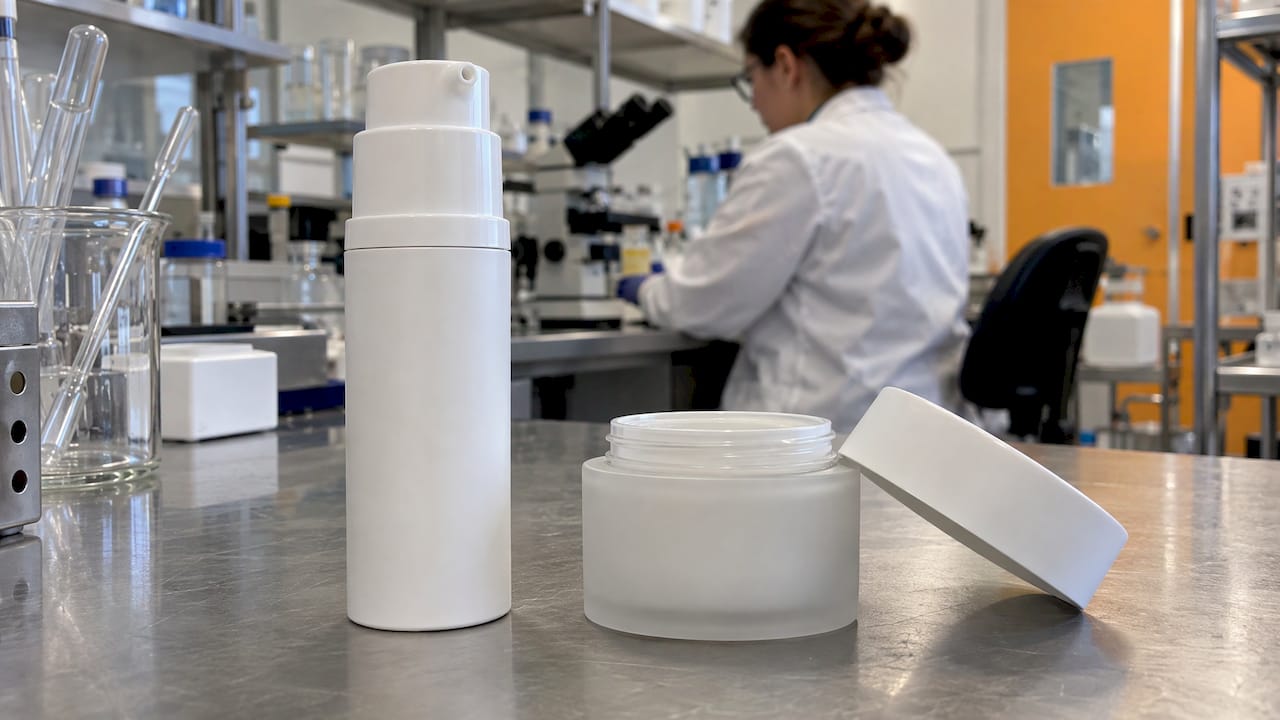
Even a well-protected retinol meets light and oxygen every time a customer opens a jar. Opaque, low-air-exposure formats are the natural pairing, and the material must be tested against the finished formula rather than assumed to be compatible. Our guide on choosing skincare packaging for your brand covers the decision, and the packaging options for Singapore brands page compares formats.
Patch testing and sensitive users
Even a gentler delivery system is still a retinoid, so your usage directions should invite a patch test and a slow introduction. This guide to patch testing skincare explains the basic routine of testing a small area before applying a new product more widely. Customers with a skin condition or who are pregnant should speak to a doctor before using any retinoid product, and your label and customer service scripts should say so.
What stability testing should assess in a retinol formula
The 2024 review concludes that testing has to be formulation-specific, because a 2021 study of commercial products found large, formulation-dependent losses and recommended real-time stability. A sound programme for an encapsulated retinol product normally covers these points:
- Active content over time. Measure retinol itself at set intervals, ideally by HPLC. The thesis above used reversed-phase HPLC to follow the ratio between retinol and its degradation product.
- Accelerated and real-time conditions. Accelerated storage at elevated temperature gives early signals, but real-time storage at normal conditions is what confirms the shelf life.
- Light exposure. Test in the final, filled pack, since light is a main driver of loss.
- Physical stability. Look at viscosity, pH, colour, odour, separation and, for carrier systems, whether the particles stay intact.
- Packaging compatibility. Check for absorption into the pack, leaching and oxygen ingress, and test the pack in use, not just sealed.
- Microbiological safety. A preservation system has to pass challenge testing with the carrier and antioxidants in place. See our note on natural preservatives that pass testing.
For a fuller walk-through, read why stability testing matters in skincare manufacturing and our guide to cosmetic stability testing for products that last.
Worked example: briefing a retinol serum
Imagine a salon group in Singapore wants a retinol night serum for take-home sale. A useful brief to a manufacturer would state:
- the target customer (first-time retinol users, or experienced users who want less flaking);
- the target concentration range and the delivery system the group prefers;
- the format, such as a serum in an opaque airless pump;
- the markets, since claims and notification requirements follow the market of sale;
- the evidence expected, such as stability data and a tolerance or efficacy test.
A manufacturer can then propose carrier options, a base, antioxidant and chelator choices, and a testing plan. The brief is also where you decide what you will say on the pack, which should follow what your tests support. Our article on skincare efficacy testing methods that build trust explains how to match claims to evidence.
Reading an encapsulation claim on a label
As a buyer or a brand owner, a few habits help you judge any “encapsulated” claim:
- Ask which carrier is used and where the supplier publishes data on it.
- Ask for stability results on a formula similar to yours, then expect to confirm them on yours.
- Check that the packaging is built for a light and oxygen sensitive active.
- Match the claim to the evidence: stability and tolerance are measurable, and a visible-results claim needs its own test.
Brands that treat the carrier as one part of a designed system tend to end up with a more consistent product than brands that treat it as a label feature.
Our perspective on encapsulated retinol
We see retinol as a project that rewards early planning. The carrier choice, the base, the antioxidant system and the pack all interact, so we prefer to settle them together in the R&D stage instead of fixing problems after the first pilot batch.
Harmony Skin Lab works as an OEM and ODM manufacturer in Singapore, and our GMP certification from HSA is part of how we run development and quality control. We work with clients on formulation, testing and packaging in one collaboration, so questions such as “which carrier suits this serum base” and “which pack protects it” are answered with the same team.
Our advice is to bring a clear brief: customer, concentration range, format and market. From there we can propose a formula direction and a stability plan, and you can see on paper how the product is designed to hold up before you commit to a full run.
Edmund
How Harmony Skin Lab can help
If you are planning a retinol serum, cream or professional treatment product, our team supports the full path from concept to filled pack: R&D and manufacturing, design and packaging, and quality control, for home-use, salon and aesthetic or doctor’s formulation lines. You can see the range on our services page, or read how custom skincare formulation works from concept to production before you talk to us.
Start a conversation through Harmony Skin Lab with your target customer, format and markets, and we will talk through the options. Smaller brands can also read about low MOQ skincare manufacturing.
FAQ
Is encapsulated retinol better than regular retinol?
It is designed to be more stable and better tolerated. Research describes better protection from light, air and heat, and a 32-person patch test found fewer doubtful reactions with the encapsulated form at 0.1%. Results still depend on the formula and the pack.
Is encapsulated retinol the same as tretinoin?
No. Retinol is a precursor that skin converts to retinaldehyde and then retinoic acid. Tretinoin is retinoic acid itself, so it acts directly. Encapsulation changes how retinol is protected and released, not what it is.
Does encapsulation make a retinol product last longer?
It can help, because the carrier shields the retinol from oxidation. The result still depends on the base, pH, antioxidants, chelators, processing and packaging, so the shelf life should be confirmed with real-time stability testing on the finished formula.
What should I ask a manufacturer before launching a retinol product?
Ask which carrier and loading they propose, how they will protect the active during processing, which packaging suits it, and what stability and tolerance testing is planned. A clear plan on these points is a good sign.
Sources
- Liposomal retinol delivery guide
- Use of Retinoids in Topical Antiaging Treatments (2022)
- Stability testing of all-trans-retinol in an experimental cosmetic formulation
- Encapsulated retinol for formulators
- What is encapsulated retinol? (Ainia, 2025)
- Supramolecular retinol study on mild photoaged facial skin (2023)
- The science of retinoids
- A Clinician’s Guide to Topical Retinoids
- HSA regulatory overview of cosmetic products
- Topical retinoids: novel derivatives and nano lipid-based systems (2024)
- EU retinol limits and stabilisation
- Patch test skincare guide